

Blocked sink in a wedding kitchen: what it looks like in real life (and why harsh chemicals aren’t net-zero)
A blocked sink is one of the fastest ways to turn a calm wedding weekend into stress. First, it’s just a smell. Then, it’s a slow draining sink. Finally, it’s a proper drain unblocking emergency, often with harsh chemicals, call-outs, and repeat problems. We’re writing this because we’ve seen the same pattern across the wedding world: the “fix” is often less sustainable than the problem.
Below are three real situations from wedding suppliers, followed by a simple, eco-friendly prevention plan.
Key Facts
Most blocked sink problems start as smelly drains and a slow draining sink, then hit during clean-down.
The usual culprit is FOG (fats, oils and grease) + tiny food scraps building up over time.
In shared kitchens, the build-up may take weeks, but the last caterer often gets blamed.
Many venues have no grease trap, so there’s no buffer for fat before it enters pipework.
“Quick fixes” with harsh chemicals often don’t stop the repeat cycle.
Why this matters for sustainability / net zero?
Harsh drain chemicals come with manufacturing + transport emissions and usually lead to repeat use.
Wastewater treatment is energy-intensive, and disruptions add extra burden to the system.
Prevention-first habits (strain, scrape, wipe fats, recycle oil) cut the need for emergency chemicals and call-outs.
The real-life situations (three wedding suppliers)
1) Venue kitchen: shared kitchen, no grease trap, goes to a digester
This is the classic venue problem. Different caterers use the same sink, often on back-to-back weekends. So, even if each team only sends a “little bit” of fat and food residue down the sink, it adds up.
What it looks like:
- The kitchen starts getting drain odours.
- The sink becomes slow draining, especially during clean-down.
- Eventually, there’s a blockage, and someone reaches for “shock” chemicals because it’s urgent.
Also, there’s a blame problem: the last caterer in the kitchen often gets blamed, even if the issue was building for weeks.

2) Caterer: moving between venue kitchens, unclear responsibility
Caterers can do everything right and still inherit problems. In their words, there’s a “grey area” around who maintains drains in shared kitchens.
What it looks like:
- You arrive and the sink already smells.
- During service, water starts pooling in the sink.
- Clean-down slows down, hygiene pressure rises, and stress spikes.
- A common bad habit they’ve seen: people tipping oil or scraps into outside drains to “get rid of it”.
3) Cake designer: home kitchen, one sink drain, lots of buttercream/chocolate
Home baking adds a different twist: there’s usually one sink, and fats are unavoidable.
What it looks like:
- A little buttercream/chocolate goes down during washing up.
- Over time, the pipe gets coated.
- First comes smell, then slow draining, then another call-out.

Why harsh drain chemicals are a sustainability and net-zero issue
1) They’re energy-intensive before you even open the bottle
Many chemical drain cleaners use strong chemistry (often based on corrosive substances). Meanwhile, key industrial chemicals like sodium hydroxide are produced via the chlor-alkali process, which uses large amounts of electricity.
So, the “quick fix” often carries hidden supply-chain emissions.
2) Wastewater treatment is already an energy-heavy system
In the UK, Ofwat notes the water sector uses about 3% of the country’s electricity and is responsible for about ~1% of UK greenhouse gas emissions.
In addition, aeration in wastewater treatment is often the biggest electricity use, commonly cited at ~45–75%.
So, when we make wastewater harder to treat, we push in the wrong direction.
3) Strong “shock” chemistry can disrupt biological treatment
Most wastewater treatment depends on microbes (activated sludge and similar biological processes). Because of that, sudden chemical stress and pH shocks can reduce performance. For example, research has found that certain chemical shocks – including high-pH shocks – can be detrimental to activated sludge processes.
4) They can worsen indoor air quality in back-of-house spaces
Many buildings have indoor VOC sources, and some cleaning activities can raise indoor organic compound levels.
So, even if something “works”, it can still be unpleasant or risky for staff in small, poorly ventilated kitchens.

A simple prevention plan that works (without drama)
Think of this as a 3-layer system. It’s easy, and it’s realistic.
Layer 1: Stop the problem at source (best win)
- Scrape food into food waste (not the sink).
- Use a sink strainer every time.
- Never pour fats/oils/grease down the drain. Wipe pans first.
- Keep coffee grounds out of sinks.
- For caterers: take oils away for proper recycling.
Layer 2: Make responsibility clear (especially in shared kitchens)
This prevents blame and protects relationships.
- Venues: include a one-line rule in your supplier pack:
“No oils, fats, or food scraps into any internal or external drains.” - Caterers: send a simple handover text at the end of service:
“Sink drained normally on arrival / was slow on arrival; cleaned strainer; no issues noted / issue reported at [time].”
Layer 3: Use a microbial drain maintainer (prevention, not panic)
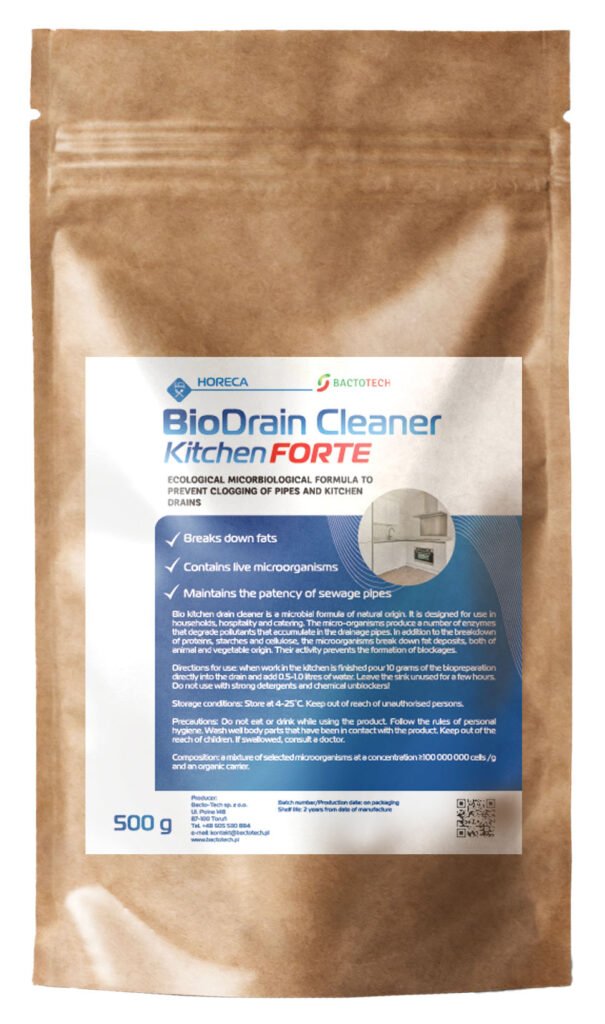
This is where BioDrain Cleaner can be a good eco-friendly option – when used as maintenance.
BioDrain Cleaner (Kitchen and FORTE) is a microbiological preparation that helps break down the organic matter that causes build-up (fats, proteins, starch, cellulose), reduces residue, and tackles odours. It is a routine use (weekly for FORTE; monthly or weekly for standard Kitchen), and it should not be used with strong detergents/chemical unblockers.
Why that is more sustainable
- It supports a prevention routine, so you need fewer emergency call-outs.
- It reduces reliance on harsh “shock” chemical clears.
- It’s aligned with how wastewater treatment works (biological breakdown), rather than fighting biology with corrosive chemistry.
Important reality check
- It won’t fix a blocked sink caused by a foreign object, broken pipe, or serious structural issue.
- It can’t replace a grease trap if the kitchen is regularly dumping fats.
- If the sink is fully blocked, you still need normal drain unblocking steps or a professional.
The simple programme
Venue kitchen (weekly)
- Keep strainers in place.
- Wipe fats before washing.
- Clean strainer + plughole area after every event.
- Apply BioDrain Cleaner FORTE weekly as directed (overnight contact time helps).
Caterer (every event)
- Arrive: check if the sink is already slow/smelly → tell venue (politely, immediately).
- During: scrape/wipe/strainer. No grounds down sink.
- Leave: strainer clean + short handover message.
Home cake kitchen (monthly or weekly if baking often)
- Wipe fats first, always.
- Strainer always.
- Monthly maintenance, or weekly during busy seasons (follow label directions).

Quick FAQs
Is BioDrain Cleaner an eco-friendly drain cleaner?
It can be, if you use it as prevention and follow the label (and still stop fats/solids at source). It’s described as microbiological and intended for preventing clogging and reducing odours.
Will it unblock a totally blocked sink right now?
It’s best for routine maintenance and reducing build-up over time. If the sink is fully blocked, use standard drain unblocking methods or call a professional.
Can I use it with chemical drain unblockers?
Don’t use it with strong detergents/chemical unblockers.
Helpful links
- BioDrain Cleaner FORTE (weekly maintenance directions).
- BioDrain Cleaner Kitchen (monthly/weekly directions).
- Ofwat on UK water-sector electricity use and emissions.
- Aeration energy share in wastewater treatment (45–75%).
- Chemical shocks and activated sludge performance.
- UK guidance on VOCs in indoor spaces.