Foliar nitrogen fixing spray is not just a new product category. It is a response to a very real field problem. You apply nitrogen, the timing looks right, and the crop still does not move as expected. So, the question quickly changes. Is the issue nitrogen supply, or is it how the crop is taking it up and using it?
BactoStym Nitro was built for that exact window. It is a foliar microbial spray designed to support nitrogen efficiency on the leaf when crop response feels patchy, slow, or uneven. In this post, we explain what it is, how it works, and how we tested it. Then we share the results from a nitrogen-free laboratory test and explain what those results may mean in practice.
Quick Answer
BactoStym Nitro is a foliar nitrogen fixing spray that supports nitrogen efficiency on the leaf surface when crops do not respond as expected.
It contains Paenarthrobacter nicotinovorans and works as a foliar microbial tool during active growth and recovery periods. In our nitrogen-free laboratory test, ammonium nitrogen rose strongly in the BactoStym Nitro series over time, while the market-leading foliar benchmark stayed much lower and finished lower at the end of the test window.
A lab is not a field. However, the test does show a clear trend that supports further on-farm testing.
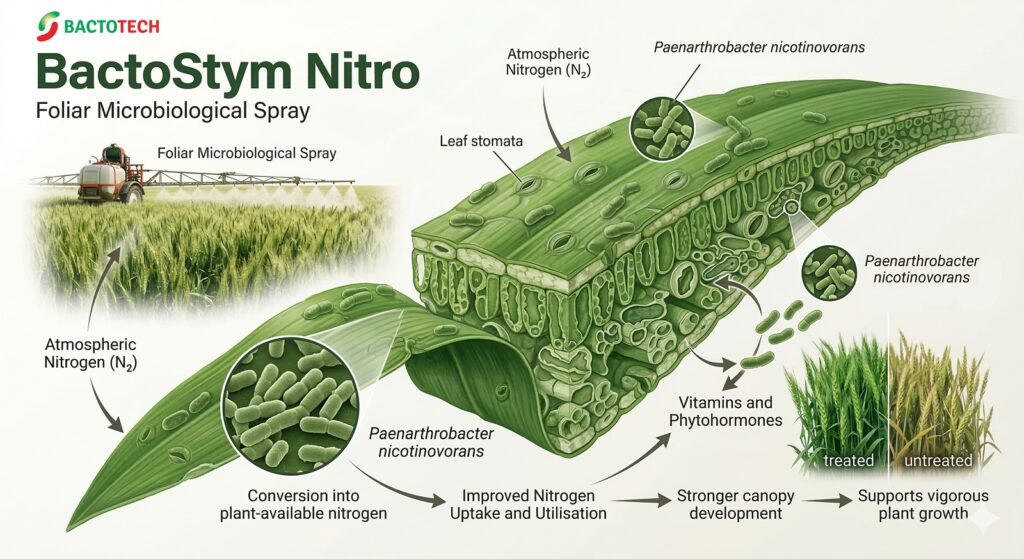
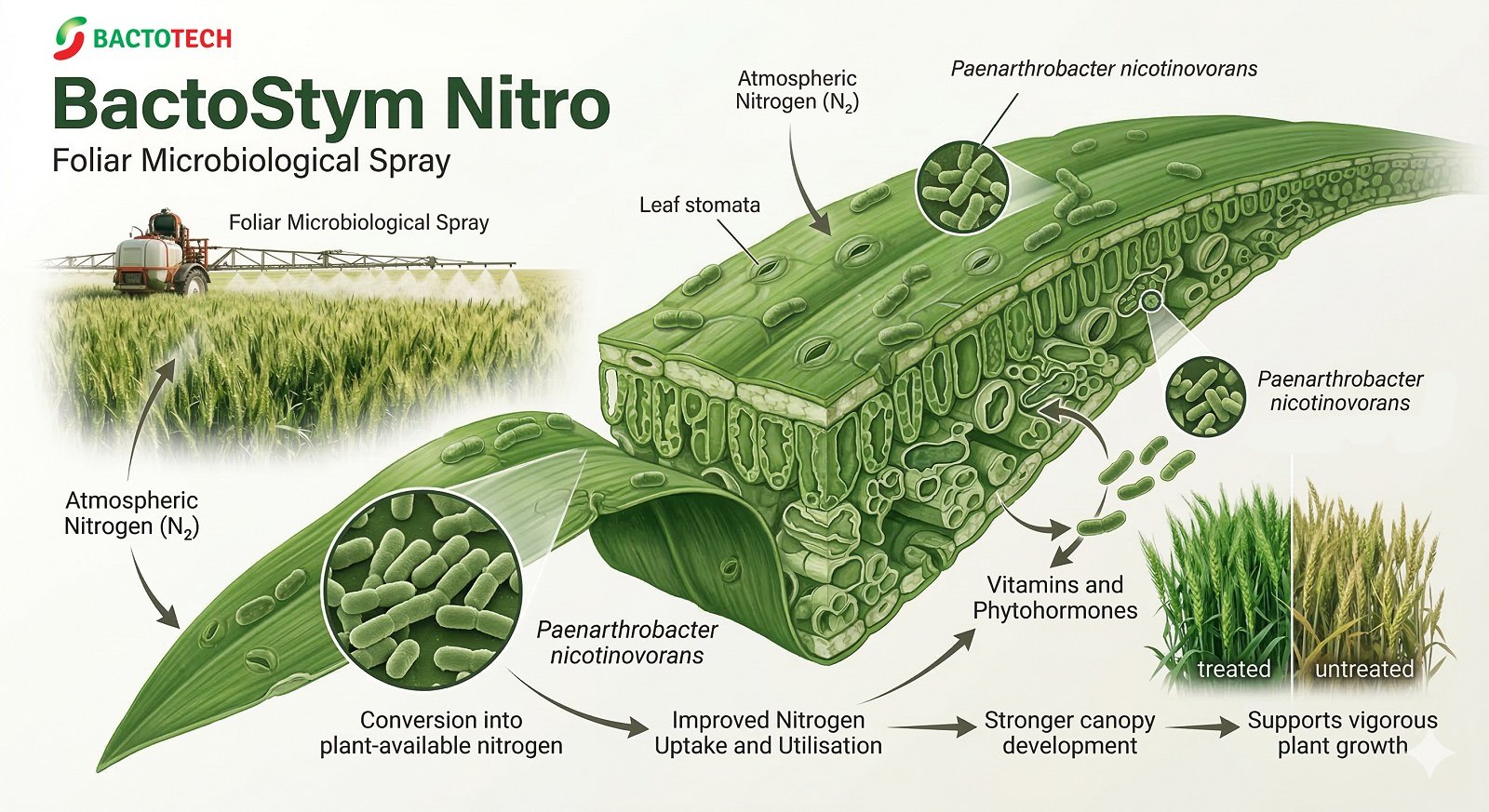
This visual explains the foliar mode of action behind BactoStym Nitro. It shows Paenarthrobacter nicotinovorans on the leaf surface and around the stomata, alongside the idea of atmospheric nitrogen being converted into plant-available forms in the leaf environment. The image also links that process to improved nitrogen uptake and use, stronger canopy growth, and more vigorous crop development. In simple terms, it helps readers understand why BactoStym Nitro is positioned as a foliar nitrogen-support tool rather than a soil-applied product.
Key Facts
Type: Foliar nitrogen fixing spray
Product: BactoStym Nitro
Biology: Paenarthrobacter nicotinovorans
Works: On the leaf surface
Rate: 1 L/ha, Water: 200–500 L/ha
Timing: Active growth and recovery, Use: 1–3 sprays per season
Mixing: Foliar feeds yes, bactericides no
Proof: Nitrogen-free lab test + independent field trials underway
When nitrogen is on, but the crop does not respond
This is the real problem behind a foliar nitrogen fixing spray. You apply nitrogen. The timing looks right. However, the crop still does not move as expected.
Sometimes the canopy stays flat, sometimes colour improves too slowly, and sometimes one part of the field pushes on, while another part stays behind. That is when the question changes. Is the issue nitrogen supply, or is the crop struggling to take it up and use it well?
This is often what it looks like in the field:
- Slow colour change after nitrogen goes on.
- Stop-start growth after cold, drought, or stress.
- Uneven crop pace across the same field.
- Different growth stages showing up side by side.
You cannot force uptake. However, you can support the crop when response turns patchy or delayed. That is where a foliar nitrogen fixing spray may fit. It does not replace the basics. Instead, it gives you another tool when nitrogen is on, but crop response still feels weak. If this field problem sounds familiar, our guide on crop not responding to nitrogen explains how to diagnose whether the issue is supply, uptake, stress, or timing.
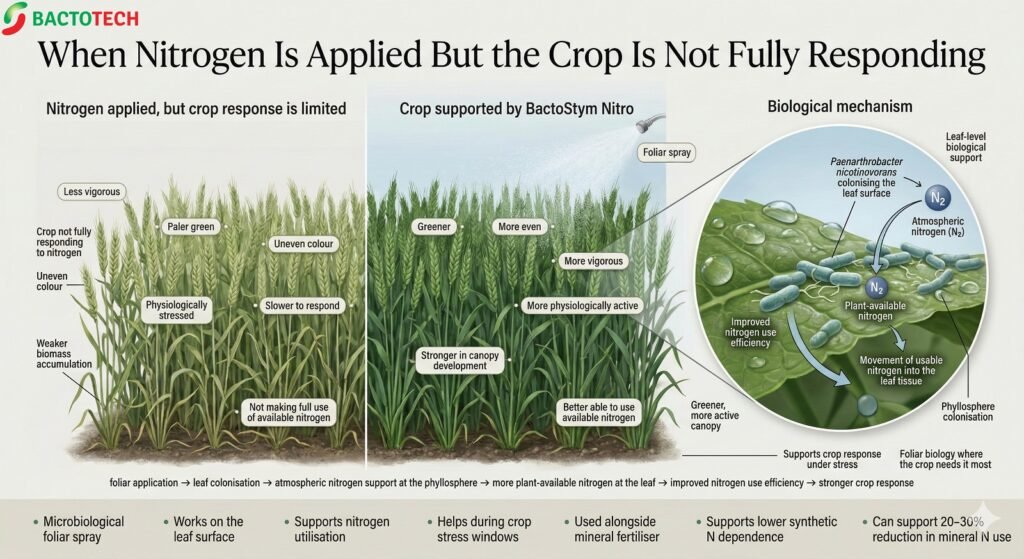
This visual explains the practical use case for BactoStym Nitro. On the left, it shows a crop that has nitrogen applied but still looks pale, uneven, less vigorous, and slower to respond. In the centre, it shows the crop after foliar support with BactoStym Nitro, with a greener, more even, and more vigorous canopy. On the right, it links that field response to the leaf-level biological mechanism, showing Paenarthrobacter nicotinovorans on the leaf surface and the product’s intended role in supporting nitrogen use efficiency during stress or uneven response periods.
What BactoStym Nitro is
BactoStym Nitro is a foliar nitrogen fixing spray. In simple terms, it works on the leaf, not mainly in the soil. That matters because the leaf has its own active surface. So, instead of placing the biology in the root zone, you place it directly onto the canopy. The product contains Paenarthrobacter nicotinovorans. We use this bacterium to support nitrogen efficiency during the moments when crops look slow, patchy, or reluctant to respond.
In practice, BactoStym Nitro fits the gap between “nitrogen is on” and “the crop still is not moving”. So, it is not a replacement for your main nutrition plan. Instead, it adds a foliar biological tool when uptake and crop response feel uneven. That is why we see it as a support product, not a miracle product. It will not fix compaction, poor rooting, waterlogging, or a missing phosphorus or potassium problem. However, it can support the crop when the leaf is the right place to act.
How a foliar nitrogen fixing spray works
Here is the simplest way to think about it. First, you spray the canopy and aim for good coverage. Then the biology lands where it needs to work: on and around the leaf surface. That matters because the leaf is not just a passive surface. It has its own active micro-zone, often called the phyllosphere. So, when you place the right biology there, you support the crop in the place where foliar interaction actually happens.
In the case of BactoStym Nitro, the aim is to support a pathway where nitrogen can appear in plant-available forms on the leaf surface over time. In plain English, the logic is this:
- You spray the crop with good coverage.
- The biology reaches the leaf surface.
- It supports nitrogen efficiency in that leaf environment.
- The crop may then respond more steadily when soil uptake is not doing enough on its own.
However, this is not a shortcut around basic agronomy. A foliar nitrogen fixing spray will not fix deep compaction, poor rooting, waterlogging, or a badly unbalanced nutrition plan. Instead, it works best as a support tool inside a wider crop programme. That is also why timing matters. The crop needs leaf area, active growth, and the ability to respond. If the crop is shut down, the spray will not rescue it on its own.
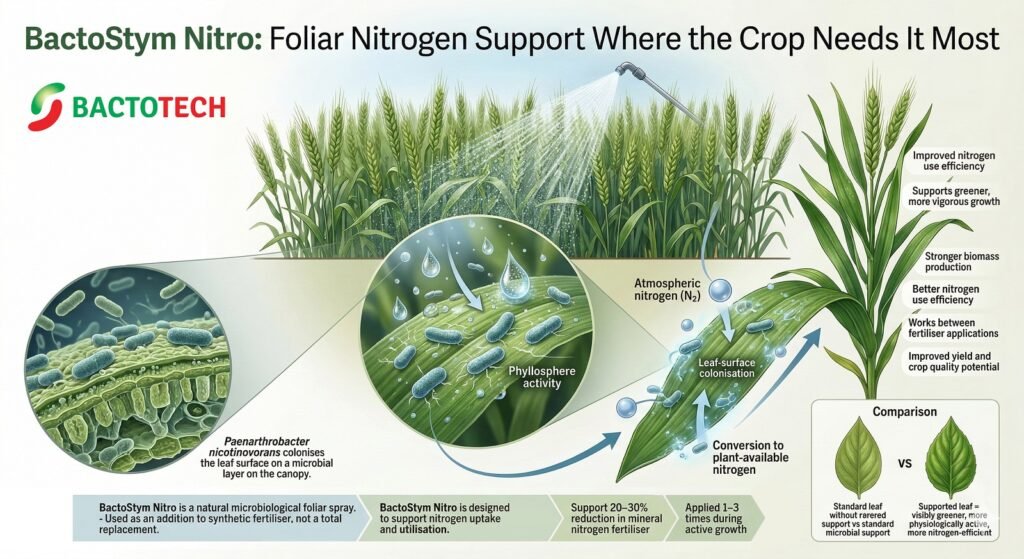
This visual explains the foliar support concept behind BactoStym Nitro. It shows Paenarthrobacter nicotinovorans colonising the leaf surface, interacting within the phyllosphere, and supporting the conversion of atmospheric nitrogen into plant-available forms on the canopy. The image then links that process to improved nitrogen use efficiency, greener and more vigorous growth, stronger biomass production, and better crop-quality potential. It also reinforces that BactoStym Nitro is intended as an addition to a wider fertiliser programme, not a total replacement.
What it is – and what it is not
BactoStym Nitro is a foliar nitrogen fixing spray that supports nitrogen efficiency when crop response turns patchy, slow, or uneven.
- It is a foliar microbial tool. So, it works through the canopy, not mainly through the soil.
- It is a way to support the crop during active growth and recovery windows. In other words, it fits the moments when nitrogen is on, but the crop still does not look right.
- However, it is not a guaranteed replacement for fertiliser.
- It is not a “spray once and forget” product.
- And it is not a substitute for good agronomy, sound timing, or a balanced nutrition plan.
The best way to think about it is this: BactoStym Nitro is a support tool. It helps you work on the leaf when the crop needs a better nitrogen response. However, it still works best when the basics are already in place. So, this product fits growers who want a practical foliar option, not a miracle claim.
Why foliar nitrogen fixing spray is getting attention in the UK
Foliar nitrogen fixing spray is getting attention because crop nitrogen uptake is not always smooth or predictable. AHDB also shows that nitrogen use efficiency can vary widely, while crop response depends on factors such as timing, crop condition, and soil nitrogen supply. That is why growers are looking more closely at tools that may support nitrogen efficiency when the field response does not match the plan on paper.
How to apply BactoStym Nitro on farm
- Use 1 L/ha in 200–500 L/ha of water. In practice, good coverage matters more than trying to “push” the dose.
- Spray during active growth and recovery windows. So, this product fits best when the crop has leaf area, is still working, and has a chance to respond.
Most growers would use it 1 to 3 times per season, depending on crop need, stress, and timing. BactoStym Nitro usually fits with foliar feeds. However, do not mix it with bactericides, because they can work against the biology you are trying to place on the leaf.
The practical goal is simple:
cover the canopy well, spray at the right moment, and keep the programme easy to repeat.
Do
- Spray when the crop is actively growing.
- Use enough water for even canopy coverage.
- Test it in a clean treated strip against a control strip.
- Keep the rest of the programme the same so the result is easier to read.
Don’t
- Do not spray into prolonged drought and expect a rescue.
- Don’t mix it with bactericides.
- Do not change too many things at once and then try to guess what worked.
How we tested it
We wanted a clean comparison. So, we removed one major source of confusion from the start. The growth medium contained no added nitrogen. That matters because it helps us see whether measurable nitrogen forms build up over time without extra nitrogen distorting the picture. We ran two series side by side.
- One series received BactoStym Nitro.
- The second series received a market-leading foliar nitrogen-fixing benchmark.
Then we sampled each series every week at three timepoints:
- T0 – starting point
- T1 – after one week
- T2 – after two weeks
Test design at a glance
| Element | What we did | Why it matters |
|---|---|---|
| Growth medium | Used a nitrogen-free medium | Removed added nitrogen from the system |
| Product series | Inoculated one series with BactoStym Nitro | Tested the product biology directly |
| Benchmark series | Inoculated one series with a market-leading foliar nitrogen-fixing benchmark | Added real category context |
| Sampling | Took samples at T0, T1, and T2 | Showed how the trend changed through time |
| Analysis | Used an independent external laboratory | Improved trust and repeatability |
This setup gave us a cleaner way to compare how the nitrogen profile changed over time in each series.
An independent external laboratory analysed the samples. The aim was simple: keep the system clean, track the nitrogen forms through time, and compare the trend between BactoStym Nitro and a leading benchmark.
What we measured
To keep the test practical and meaningful, we tracked three nitrogen measures:
- Ammonium nitrogen (NH₄-N)
This is a plant-available nitrogen form.
- Nitrite nitrogen (NO₂-N)
This is a short-lived intermediate in nitrogen pathways.
- Kjeldahl nitrogen (TKN)
This measure includes ammonium nitrogen plus organic nitrogen.
Together, these three measures gave us a clear view of how the nitrogen profile changed through time.
Independent field trials now underway
Last season, we also started on-farm field trials of BactoStym Nitro. An independent accredited institution is running these trials under a recognised system used for this type of agronomic evaluation. As a result, other research centres across Europe can also recognise the final data.
The full field results are still being processed, and we expect them within the next few months. For now, we are sharing the nitrogen-free laboratory data because it gives a clean, controlled view of how key nitrogen forms changed over time. Then, the field trials will add the real-world picture under practical farm conditions.
Test results: what changed through time
This side-by-side view shows the main trend clearly: BactoStym Nitro drove a much stronger ammonium nitrogen response over time, while the leading foliar benchmark stayed low.
| Measure | Leading foliar benchmark | BactoStym Nitro | Main takeaway |
|---|
| Nitrite nitrogen (NO₂-N) | Stayed below quantification limit at T0, T1, T2 | Stayed below quantification limit at T0, T1, T2 | No measurable nitrite build-up in either series |
| Kjeldahl nitrogen (TKN) | Fell from 223 to 118 | Rose overall from 129 to 170 | BactoStym Nitro finished higher, while the benchmark trended down |
| Ammonium nitrogen (NH₄-N) | Stayed low and fell to 0.6 by T2 | Rose strongly from 1.5 to 60.9 by T2 | This was the clearest difference in the test |
Nitrite nitrogen (NO₂-N)
| Timepoint | Leading foliar benchmark | BactoStym Nitro | Unit |
|---|---|---|---|
| T0 | <0.02 | <0.02 | mg/dm³ |
| T1 | <0.02 | <0.02 | mg/dm³ |
| T2 | <0.02 | <0.02 | mg/dm³ |
Takeaway: Nitrite stayed below the lab quantification limit in both series across the full test window.
Kjeldahl nitrogen (TKN)
| Timepoint | Leading foliar benchmark | BactoStym Nitro | Unit |
|---|---|---|---|
| T0 | 223 | 129 | mg/dm³ |
| T1 | 166 | 166 | mg/dm³ |
| T2 | 118 | 170 | mg/dm³ |
Takeaway: The leading foliar benchmark trended down through time. By contrast, BactoStym Nitro rose overall and finished higher at T2.
Ammonium nitrogen (NH₄-N)
| Timepoint | Leading foliar benchmark | BactoStym Nitro | Unit |
|---|---|---|---|
| T0 | 3.0 | 1.5 | mg/dm³ |
| T1 | 4.7 | 35.7 | mg/dm³ |
| T2 | 0.6 | 60.9 | mg/dm³ |
Takeaway: This was the clearest difference in the test. Ammonium nitrogen rose sharply in the BactoStym Nitro series, while the leading foliar benchmark stayed low and finished lower at T2.
Best-fit situations on farm
BactoStym Nitro fits best when the crop has nitrogen on paper, but the field response still feels weak, patchy, or delayed. In practice, it makes most sense in these situations:
- After stress
For example, after a cold check, a dry spell, or another setback, when the crop starts moving again but still looks uneven.
- When canopy response feels patchy
One part of the field pushes on, while another part lags behind, even though the nutrition plan looks right.
- When you want foliar support, not another soil input
If the problem sits in crop response and canopy pace, a foliar nitrogen fixing spray may fit better than adding yet another soil-applied product.
- When the crop still has leaf area and the ability to respond
This matters because the spray works on and around the leaf. So, active growth and decent canopy coverage give it the best chance to perform.
At the same time, BactoStym Nitro tends to fit less well in these situations:
- Prolonged drought shutdown
If the crop has largely stopped functioning, no foliar spray will act like a rescue plan on its own.
- Root problems are the real limiter
Compaction, waterlogging, and poor rooting still need fixing at the root-cause level.
- Nitrogen is not the main issue
If phosphorus, potassium, sulphur, pH, or soil structure is the real bottleneck, then a foliar nitrogen tool will not solve the wrong problem.
So, the best way to think about BactoStym Nitro is this: It fits the window where the crop can still respond, the canopy is active, and nitrogen efficiency needs support. It does not replace the basics. However, it can add a useful tool when the field still looks flat after nitrogen goes on.
Foliar Nitrogen Fixing Spray FAQs:
Can BactoStym Nitro replace fertiliser?
No. BactoStym Nitro works best as a support tool, not a full replacement for fertiliser. It helps support nitrogen efficiency when crop response turns patchy or delayed.
When should I spray BactoStym Nitro?
Spray during active growth and recovery windows. In other words, use it when the crop still has leaf area, is still working, and still has the ability to respond.
What water rate should I use?
Use 200–500 L/ha. In practice, good coverage matters more than trying to push the dose.
How many times should I use it in a season?
Most growers would use it 1 to 3 times per season. However, the final programme should still match crop need, stress level, and timing.
Can I mix it with foliar feeds?
Usually, yes. However, avoid bactericides in the same tank mix, because they can work against the biology you want on the leaf.
How quickly should I expect to see anything?
That depends on crop condition and timing. Often, the first signs are canopy pace, colour, and crop uniformity. Then, later on, you confirm the result with yield, quality, or both.
Does it work through the soil?
No, that is not the main idea. BactoStym Nitro works on and around the leaf surface, so it fits growers who want a foliar nitrogen-support tool rather than another soil input.
When is it less likely to help?
It is less likely to help if the crop is shut down in prolonged drought, if root damage is the real problem, or if nitrogen is not the main limiting factor.
What is the best way to test it on farm?
Keep it simple. Run one treated strip and one untreated strip in the same field, then keep everything else the same. That makes the result much easier to read.
What do the lab results actually show?
The lab results show that, in a nitrogen-free medium, ammonium nitrogen rose strongly in the BactoStym Nitro series over time. They do not prove field performance on their own. However, they do show a clear trend that supports further farm testing.
BactoStym Nitro: the practical next step
If you want to test BactoStym Nitro properly, start with one field, not ten. Pick a field where nitrogen is on, but the crop still looks flat, patchy, or slow to respond. Then set up one treated strip and one untreated strip. Keep the rest of the programme the same, and watch what happens. That approach gives you something much more useful than guesswork. It gives you a fair comparison in your own conditions.
In simple terms, BactoStym Nitro fits the moment when timing looks right, but crop response still feels weak. So, if you have ever stood in a field and thought, “the nitrogen is on, but the crop still will not move,” this is the product we would test first. If the strip shows a cleaner response, stronger canopy pace, or better uniformity, you have a practical next step. If not, you still learn something valuable about what is really limiting the crop.
That is the right way to use a foliar nitrogen fixing spray:
start small, keep it simple, and prove it in the field.

Editorial note
This post is based on BactoStym Nitro product information, a side-by-side internal comparison in a nitrogen-free growth medium, and laboratory analysis by an independent external lab. We are also running independent field trials through an accredited institution, and those results will follow separately once the work is complete.
We are sharing the lab data to be transparent. However, we still recommend proving performance with a simple strip trial in your own conditions, because crop response will always depend on timing, stress, weather, canopy condition, and the wider nutrition plan.
Related guides
If your main problem is weak crop response after nitrogen timing, read our guide on crop not responding to nitrogen for a practical field diagnosis and a simple way to separate supply problems from uptake problems. Are you looking at the bigger nutrient-efficiency picture? Our guide on how to reduce nitrogen fertiliser use explains what to measure, where biological tools fit, and how to keep the programme practical. If you want the wider product overview, visit the BactoStym Nitro page for the core product information and use guidance.