Wheat seed treatment lifts crop performance. Importantly, it does so without harming emergence or tillering. In our spring wheat trial, yield increased by 12%. Below, we explain the trial set-up, the results you can expect, and how to measure benefits on your own farm.
Key takeaways (at a glance)
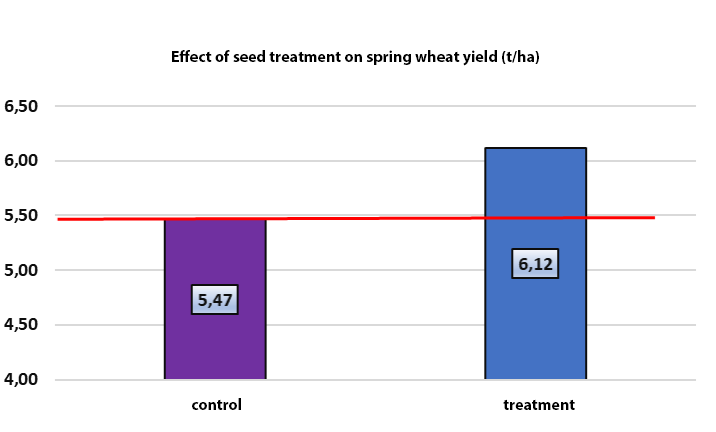
+12% yield. Treatment hit 6.12 t/ha vs 5.47 t/ha in the control.
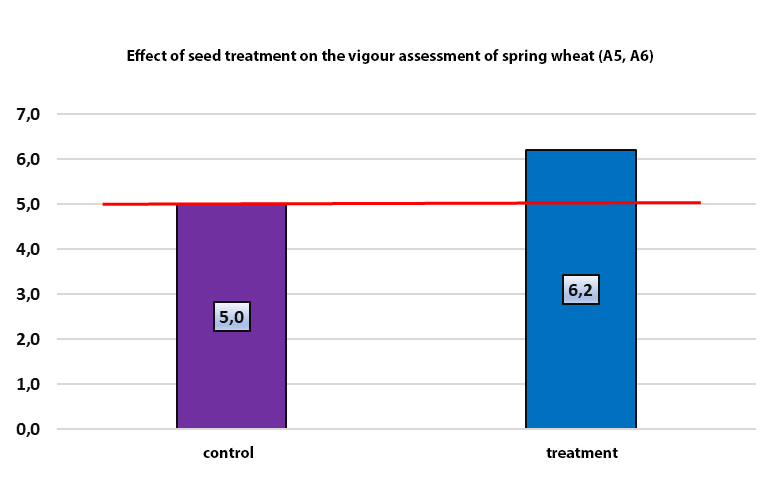
Stronger vigour. Through June, crop vigour tested higher (significant).
No penalty. Emergence and tillering matched the control.
Lower disease. Powdery mildew (Blumeria graminis) appeared slightly lower.
Trial at a glance
- Crop & variety: Spring wheat, Servus.
- Comparison: Untreated control vs. microbiological seed dressing (10 g/kg).
- Soils: Sandy loam (pH 5.9; sand 60.6%, silt 36.5%, clay 2.9%; fertility level: G).
- Assessments: Emergence, tillering, disease, vigour (1-10 scale), yield.
In short, the design allows a clear side-by-side check under known soil conditions, so results link directly to the seed dressing.
Seed preparation & sowing
- Before sowing, we moistened the grain at 1 L water per 50 kg seed.
- Then, we applied the microbiological dressing.
- After that, we drilled the seed with a 3 m field drill.
- Finally, we set up equal-sized plots for treated and untreated seed, so the comparison stayed fair.
Methods
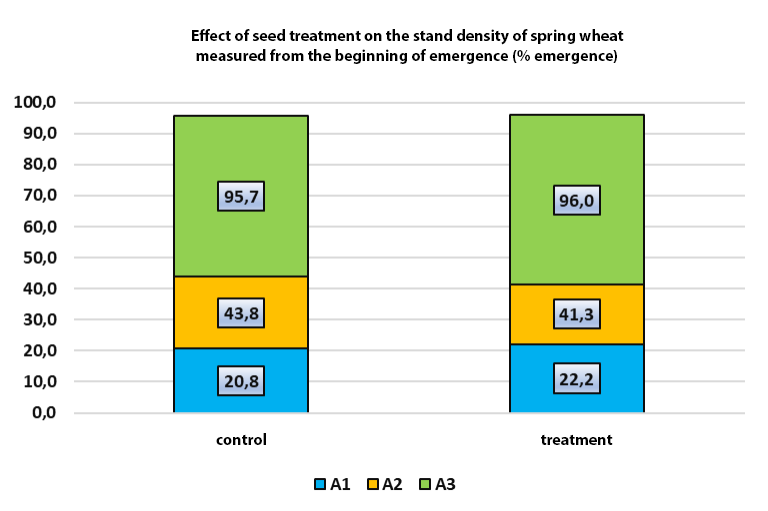
- For consistency, we checked emergence three times (16, 20, and 30 April) by counting plants along fixed row sections. This approach stays robust and repeatable.
- To spot real differences, we assessed tillering on 15 randomly chosen plants per plot. That sample size gives useful power.
- In June, we monitored disease twice, focusing on powdery mildew, the only leaf disease present.
- During key stages, we rated vigour visually on a 10-point scale, so scores stayed clear and comparable.
- At harvest, we measured yield and ran stats, which confirmed the 12% uplift was significant.
Results
Emergence
Across all three counts, treated and untreated plots showed similar, even emergence. Importantly, this result confirms the dressing is selective and safe for seedlings.
Disease pressure
On site, only powdery mildew showed up. At the first June check, infection averaged 2.0% in the control and 1.7% in the treated plots. So, the dressing showed a modest reduction in disease.
Plant vigour (visual 1–10)
Throughout the season, treated wheat looked stronger. In early to mid-June (A5/A6; 3 and 17 June), average vigour in treated plots reached 6.2. Importantly, this was a statistically confirmed improvement over the control. As a result, plants maintained better condition during key growth stages.
Yield
Here’s the clear gain.
Control: 5.47 t/ha
Treated: 6.12 t/ha (+12%, statistically significant)
Therefore, the seed treatment delivered a real uplift. In practice, that increase often covers the cost of treatment and adds margin. So, many farms finish the season ahead.
What This Means on Farm:
Because emergence and tillering stayed steady, the yield gain likely comes from healthier, more vigorous plants. They coped better with early pressure and turned resources into grain more efficiently. In short, you keep the stand you planned and finish stronger at harvest.
What You Can Expect:
- Overall, plants look stronger and healthier, with higher visual vigour.
- Moreover, the treatment helps crops cope with early disease pressure.
- Most importantly, you gain a proven, measurable yield lift without harming emergence or tillering.
Curious how a microbiological seed dressing will perform on your soils? Interested in wheat seed treatment but want a simple start? Get in touch, and we’ll help you plan a small, low-risk, on-farm comparison this season. That way, you see the results on your own fields and with your own kit – before you scale up.