Azotobacter vinelandii is a well-known soil bacterium. Farmers are interested in it because it can help with nitrogen use, root growth, and crop strength. It does not need to live in a legume nodule like Rhizobium. However, it works best as part of a wider soil and crop plan.
If you are trying to grow a healthier crop with better nitrogen use, this species is worth knowing. It is one of the better-known free-living nitrogen-fixing bacteria in soil. That matters because it may help crops in more than one way, not only through nitrogen, but also through better root activity and better access to nutrients.
What is Azotobacter vinelandii?
Azotobacter vinelandii is a soil bacterium that lives freely in the root zone. Unlike Rhizobium, it does not need to form nodules on legumes to play a role in nitrogen fixation. It is best known for helping fix nitrogen under aerobic soil conditions, and research also links Azotobacter species with plant-growth effects and nutrient support.
If you want the wider picture, our guide to soil microbes for farming explains what the main microbial groups do and when they help. For a technical overview, ScienceDirect describes Azotobacter vinelandii as a free-living soil bacterium known for nitrogen fixation under aerobic conditions.
Quick Answer
Azotobacter vinelandii is a free-living soil bacterium that helps turn nitrogen from the air into forms linked with plant growth. It may also support roots and help crops use nutrients better. On farm, it fits best where the goal is better nitrogen use and stronger root-zone biology.
However, it will not fix deeper soil or crop problems on its own.
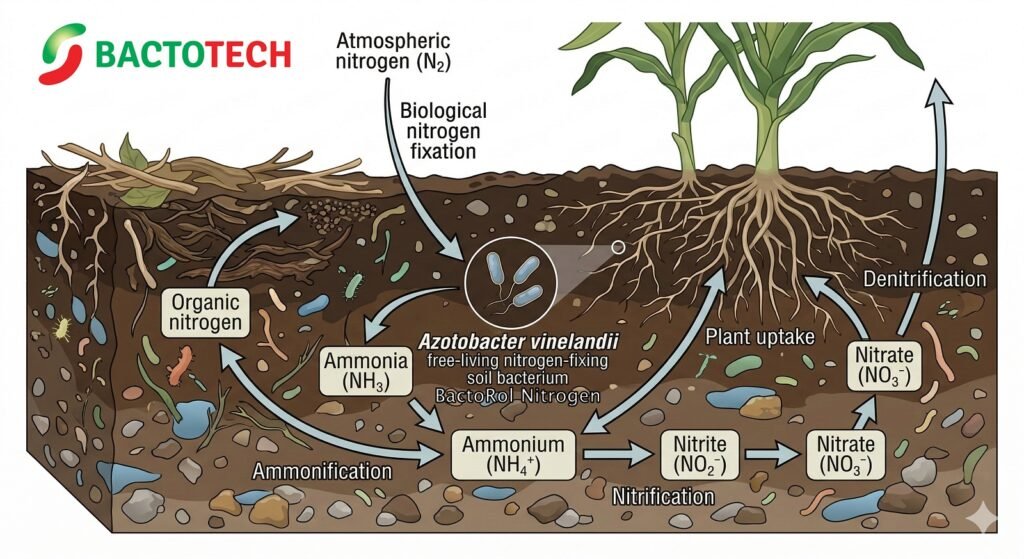
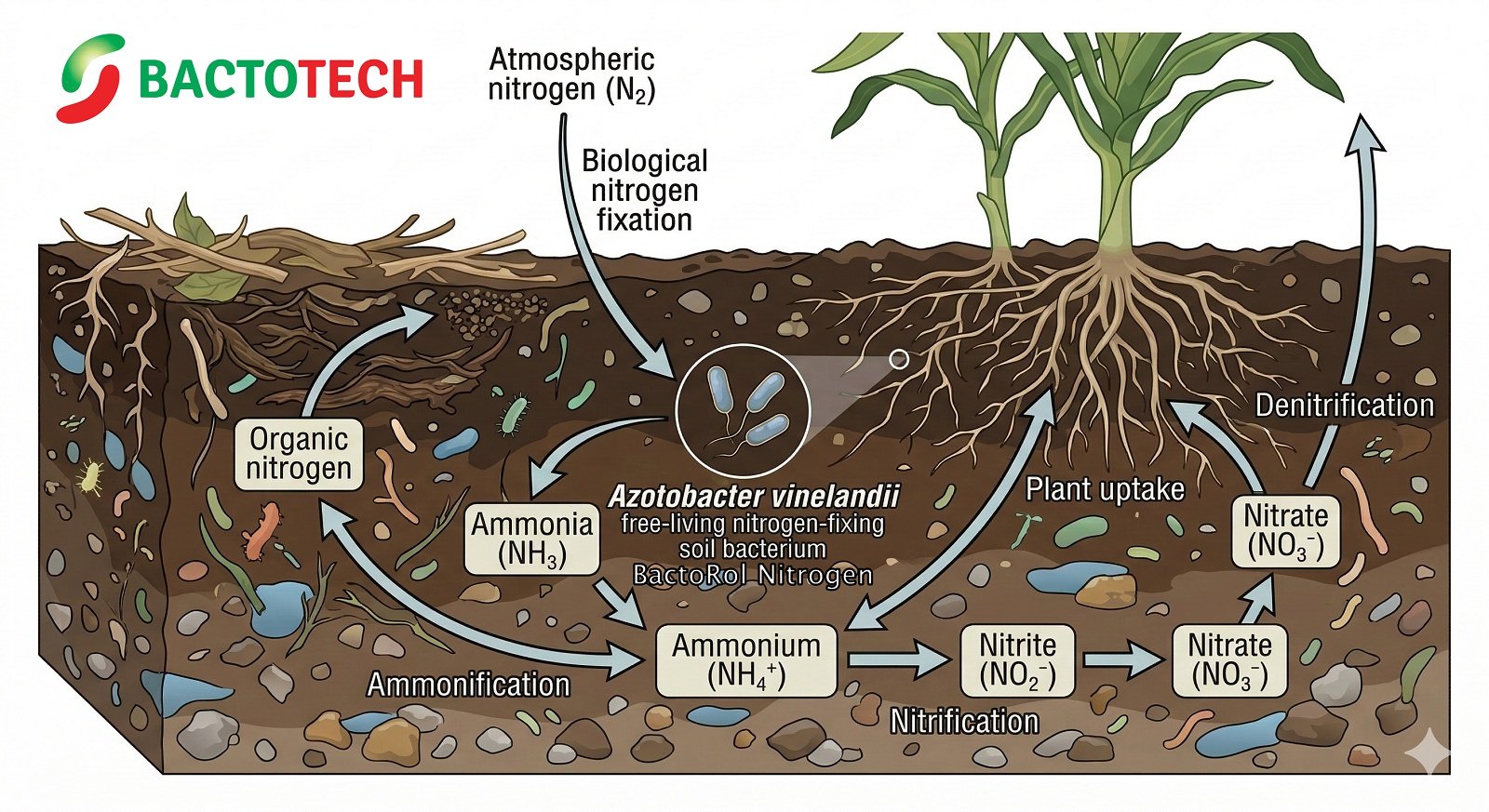
This soil cross-section illustration shows Azotobacter vinelandii at work in the root zone. It explains how this free-living nitrogen-fixing bacterium helps turn nitrogen from the air into forms linked with plant nutrition, while also showing the wider nitrogen cycle in the soil. With crop roots, organic matter, and key stages like ammonification, nitrification, plant uptake, and denitrification clearly labelled, the image helps readers understand how biology and crop nutrition connect below the surface.
Key Facts
Main role – Helps fix nitrogen in soil.
What makes it different – It lives freely in soil and does not need a legume nodule.
Other benefits – It may help roots, crop growth, and nutrient use.
Best fit – Fields where nitrogen use is weak or root activity needs support.
Not a full fix for – Compaction, poor pH, waterlogging, or poor seedbeds.
What to check first – Root depth, soil structure, moisture, and crop nutrition.
How to spot where it may fit
| What you notice in the field | Likely issue underneath | What to check first | Where Azotobacter vinelandii may fit |
|---|
| Crop looks pale or slow even after N was applied | Weak nitrogen use, root stress, or poor soil life | Root depth, moisture, timing of N, compaction | It may help support better nitrogen use in the root zone |
| Growth is uneven across the field | Establishment or soil structure problem | Dig roots in good and poor patches | It may help later, but it will not solve poor establishment by itself |
| Crop struggles in dry periods | Stress is limiting uptake and growth | Soil moisture, rooting depth, soil condition | It may support the crop as part of a wider stress plan |
| Legumes perform poorly | Nodulation or rhizobium problem | Check nodules, pH, and inoculation history | It does not replace the right rhizobium for legumes |
| You want to cut synthetic N risk | Need steadier nitrogen use, not guesswork | Soil N supply, crop demand, timing | It fits best as support for nitrogen efficiency |
How does Azotobacter vinelandii help crops?
- First, Azotobacter vinelandii is known for free-living nitrogen fixation. That means it can help add useful nitrogen to the root zone without depending on a legume nodule. This is one reason it is often discussed in lower-input and nitrogen-efficiency systems.
- Second, Azotobacter species are linked with compounds that may support plant growth. These include substances linked with longer roots, more root hairs, and stronger early growth. In simple terms, the value is not only about nitrogen. It is also about helping the crop build a stronger root system so it can make better use of what is already in the soil.
- Third, research also links Azotobacter species with better nutrient access, including phosphorus support in some cases. That matters because many crop problems are not caused by one nutrient alone. In the field, better crop response often comes from several small gains working together.
- A review in Frontiers in Microbiology explains that Azotobacter species are linked not only with nitrogen fixation, but also with plant-growth effects and nutrient support.

When can Azotobacter vinelandii help most on farm?
This species makes most sense where the goal is better nitrogen use, not miracle claims. It fits best in fields where the crop needs more steady support from the root zone and where the wider agronomy is already sound. That means decent soil structure, sensible nutrition, and a crop that still has room to respond.
It may be especially useful when fertiliser costs are high and you want to improve how well the crop uses each unit of nitrogen. AHDB’s work on nitrogen use efficiency shows that crop response depends on soil supply, crop demand, and timing. So the best way to think about Azotobacter vinelandii is not as a full fertiliser swap, but as one tool that may help improve the whole system.
If your main goal is better nitrogen use, our guide on how to reduce nitrogen fertiliser use explains where biology can fit into a practical farm plan. For the practical UK angle, AHDB’s work on nitrogen use efficiency is a useful reminder that crop response depends on soil supply, crop demand, and timing.
Where will it not solve the problem alone?
This is important. Azotobacter vinelandii will not fix deep compaction, poor drainage, severe pH problems, poor seed placement, or badly timed nutrition on its own. If roots cannot move, if water sits in the soil, or if the seedbed was poor from the start, then the main problem is still physical or agronomic. Biology can help, but it cannot carry the whole field by itself.
That is why good diagnosis comes first. Before blaming nitrogen, dig roots. Check moisture, structure and how even the crop is. A biological product works best when it is supporting a good plan, not trying to rescue a bad one.
Azotobacter vinelandii vs Rhizobium vs Bacillus
These names are often mentioned together, but they do different jobs.
| Microbe | Main role | Best known use | Key point |
|---|
| Azotobacter vinelandii | Free-living nitrogen fixation and plant-growth support | General root-zone support and nitrogen use | Lives freely in soil |
| Rhizobium | Nitrogen fixation in legume nodules | Legume crops such as beans, peas, clover | Needs the right plant partner |
| Bacillus species | Root support, nutrient cycling, stress support, disease pressure help | Broad support across many crop systems | Often valued for wider soil and root benefits |
Azotobacter vinelandii is useful because it does not need the same close plant partnership as Rhizobium. Bacillus species, on the other hand, are usually discussed more for root health, nutrient cycling, and crop support than for exactly the same role as Azotobacter. So these microbes are not copies of each other. They can sit in the same wider soil-health picture, but they do not do the same job.
For legumes, it also helps to read our guide on poor nodulation in legumes, because free-living nitrogen support is not the same as reliable nodulation.
What new research says about Azotobacter vinelandii
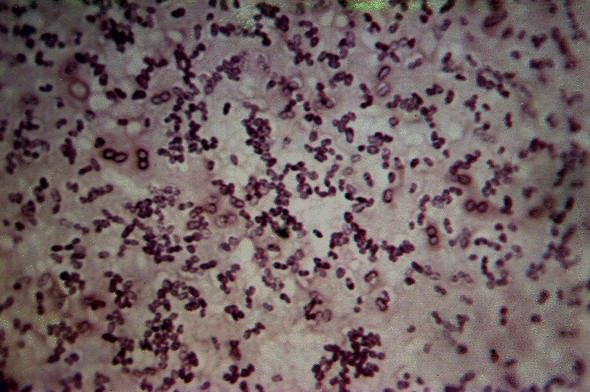
One of the most interesting newer findings is that Azotobacter vinelandii may work even better in the right microbial mix. A 2024 study found that, under low-nitrogen conditions, A. vinelandii fixed more nitrogen when grown with Bacillus subtilis than when grown alone. Total nitrogen input was about twice as high in the mixed system.
That does not mean every mixed product will behave the same way in every field. Field conditions are always more complex than lab work. Still, this is an important finding because it supports the idea that the right microbial partners may matter a lot. For growers, that means it is worth thinking about biology as a working team, not only as single species in isolation.
For newer evidence, this 2024 study found stronger nitrogen fixation by Azotobacter vinelandii in co-culture with Bacillus subtilis under low-nitrogen conditions.
How to judge whether it is helping
If you use a product built around Azotobacter vinelandii, do not judge it only by colour in the crop. Try to measure simple field signs.
| What to measure | Why it matters |
|---|
| Root depth | Shows whether the crop is exploring soil well |
| Root mass | Helps show whether the root system is stronger |
| Crop colour and evenness | Gives an early view of growth and nitrogen response |
| Tissue tests | Helps check whether the crop is actually taking up nutrients better |
| Yield and grain quality | Shows whether the response turned into real farm value |
| Treated vs untreated strip | Helps separate real response from field variation |
This matters because many biology claims sound good in theory. However, the farm decision should still come back to visible response, crop numbers, and margin. That is where trust is built.
Where this species fits in a real farm plan
Azotobacter vinelandii fits best as part of a wider programme for better nitrogen use and stronger root-zone biology. In practice, that means it sits alongside good soil structure, sensible nutrition, and good timing. It is not the first thing to fix if the field has serious drainage or compaction issues. However, once the basics are in place, it may help lift how well the crop uses the system around it.
For BactoTech UK, this species matters because it supports the wider goal of using biology to make crop nutrition work better. That is also why it fits naturally into conversations about reducing waste, supporting roots, and getting more from each hectare without leaning only on more bagged input.
The products behind this idea
At BactoTech UK, Azotobacter vinelandii fits most clearly into our nitrogen-efficiency story. It is relevant where growers want to support root-zone biology and improve how the crop uses available nitrogen. In practical terms, that makes it useful in programmes focused on better nitrogen use, steadier crop growth, and stronger soil life.
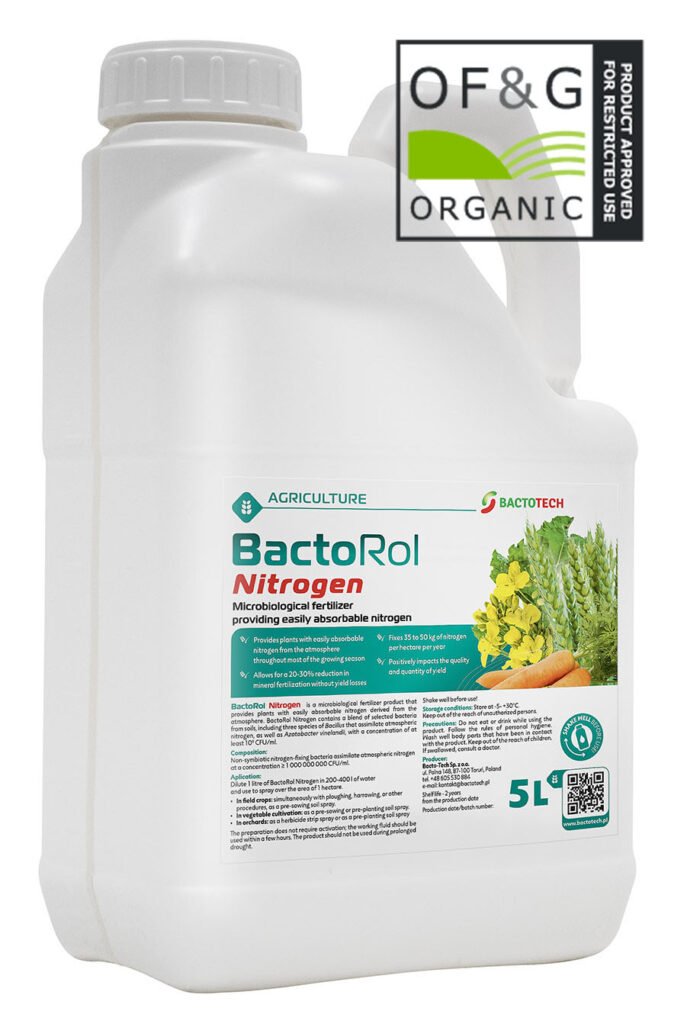
If you want to see where this biology fits in our range, the most relevant pages are BactoRol Nitrogen and BactoViN. Those pages explain how we connect this species to real farm use, while this guide stays focused on the species itself.
Azotobacter Vinelandii – FAQs
What is Azotobacter vinelandii?
It is a free-living soil bacterium linked with nitrogen fixation and plant-growth support.
Is Azotobacter vinelandii the same as Rhizobium?
No. Rhizobium is known for forming nodules on legumes. Azotobacter vinelandii lives freely in soil.
Can Azotobacter vinelandii replace nitrogen fertiliser completely?
That is too strong for most real farm situations. A safer view is that it may help improve nitrogen use as part of a wider crop plan.
Does Azotobacter vinelandii help roots?
Research on Azotobacter species links them with plant-growth substances that may help root growth and early plant vigour.
Can it help in stressful conditions?
Some research suggests Azotobacter species may help crops under drought or salt stress. However, field response still depends on soil, weather, and the wider crop plan.
Can Azotobacter vinelandii work with Bacillus species?
Potentially yes. A 2024 study found stronger nitrogen fixation when A. vinelandii was grown with Bacillus subtilis under low-nitrogen conditions.
What is the biggest mistake when talking about Azotobacter vinelandii?
Treating it like a one-step fix for every nitrogen problem. Good diagnosis still comes first.
Want to improve nitrogen use in your crops? Talk to BactoTech UK about your field, your crop, and where Azotobacter vinelandii may fit in your wider soil and crop plan.
Editorial note
This guide is for general information only. Field response depends on soil type, crop, weather, timing, and the wider farm programme. Always match biological products to good field diagnosis and follow product guidance and local rules.