
Reducing crop losses and fertiliser dependence across supplier farms: a TRL 7+ candidate microbial crop-nutrition programme
How BactoTech UK, a UK-based agri-tech startup, uses four complementary microbial technologies to support crop establishment, nutrient availability, nitrogen-use efficiency, crop uniformity and lower-input production systems.
Why this matters
Every crop that fails to establish evenly, develops inconsistently or falls outside market specification represents more than a loss of food. It also represents land, water, fertiliser, labour and energy that have already been used without producing a saleable product.
For food retailers, food-service buyers and their suppliers, reducing crop losses and improving crop output is therefore both a sustainability challenge and a commercial resilience challenge. The most valuable technologies are not those that sound impressive in isolation, but those that can be deployed on real farms, fit into existing crop-production programmes and scale across a broad supplier base.
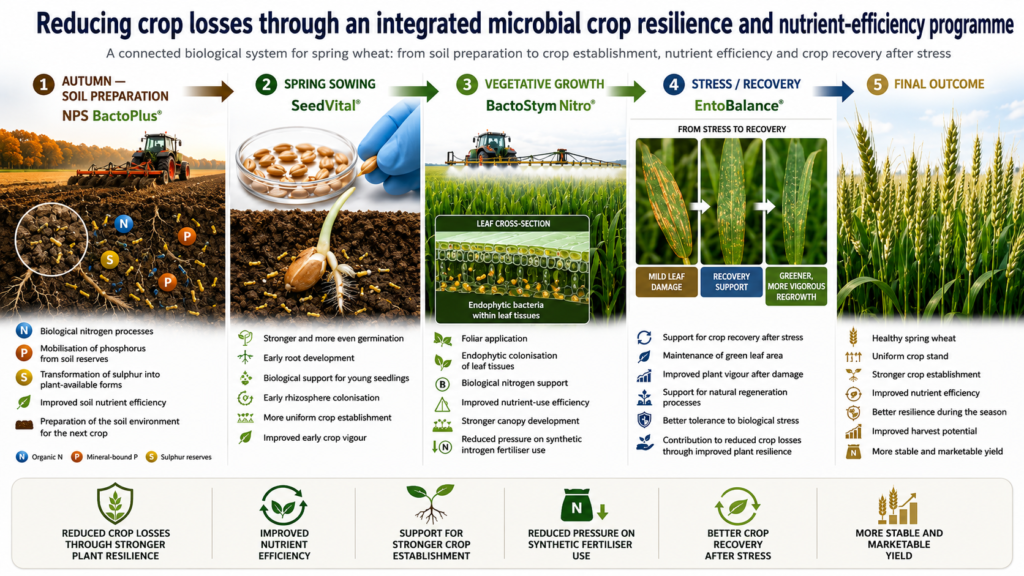
BactoTech UK has developed an integrated microbial crop-nutrition and nutrient-efficiency programme designed to support crops from planting to harvest:
NPS BactoPlus → SeedVital → BactoStym Nitro → EntoBalance
Together, these four technologies are designed to support crop establishment, nutrient availability, nitrogen-use efficiency, root and canopy development, crop performance under variable growing conditions, the proportion of harvested produce that meets market requirements.
The programme is not intended to replace good agronomy or every conventional input. Its purpose is to integrate biological technologies into existing production systems, helping farmers and growers protect the investment already made in the crop and produce more marketable food from the resources used.
At a glance: fit with retailer and supplier-farm priorities
| Retailer/supplier priority | BactoTech fit | Food supply-chain value |
| Reducing crop losses and avoidable food waste | Four-stage microbial programme supports establishment, nutrient efficiency and crop uniformity from planting to harvest. | More marketable produce and fewer crops lost because of poor establishment, uneven development or failure to meet specification. |
| Soil health, environment and biodiversity | Root-zone microbial activity supports nutrient cycling, phosphorus mobilisation, sulphur transformation and balanced plant nutrition. | Better use of nutrients already present in the soil and improved efficiency of fertiliser programmes. |
| Emissions reduction and input efficiency | The programme enables a measured reduction of synthetic nitrogen and phosphorus fertilisers by up to 30% without compromising yield or quality. | Lower dependence on manufactured fertiliser inputs and a practical pathway to lower crop-production footprint. |
| On-farm quality improvements | Seed, root-zone and foliar technologies work together to support uniformity, crop condition and yield structure. | More produce meeting retailer, storage, processing and consumer specifications. |
| Practical on-farm adoption | Designed to fit standard farm equipment, spray programmes, liquid fertiliser programmes and seed/planting-material treatment systems, subject to compatibility checks. | No new machinery requirement and no major workflow disruption for supplying farmers. |
| TRL 7+ candidate readiness | Field-validated and positioned as a TRL 7+ candidate for a structured supplier-farm pilot, with existing independent crop evidence and external laboratory nitrogen data. | A low-disruption trial can be launched with measurable commercial, agronomic and environmental KPIs. |
The challenge: crop losses do not begin at harvest
Crop losses often start long before the crop reaches the packhouse or processing line. Poor germination, weak establishment, uneven early development, nutrient inefficiency, drought or cold conditions, variable soils and restricted root development can all reduce the proportion of a crop that becomes saleable food.
Even where total yield appears acceptable, a significant proportion may still be lost because produce is too small, uneven in size or maturity, unsuitable for storage or processing, or outside retailer and consumer specifications.
BactoTech’s approach is to intervene at several connected stages of the crop cycle, rather than relying on a single biological product applied in response to one isolated agronomic challenge.

One programme, four complementary microbial technologies
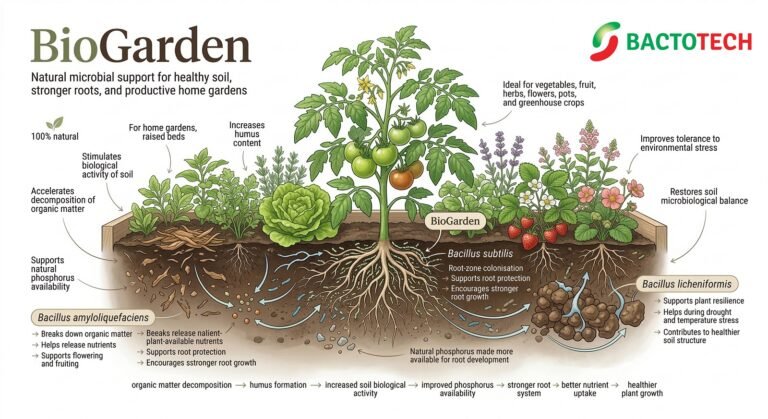
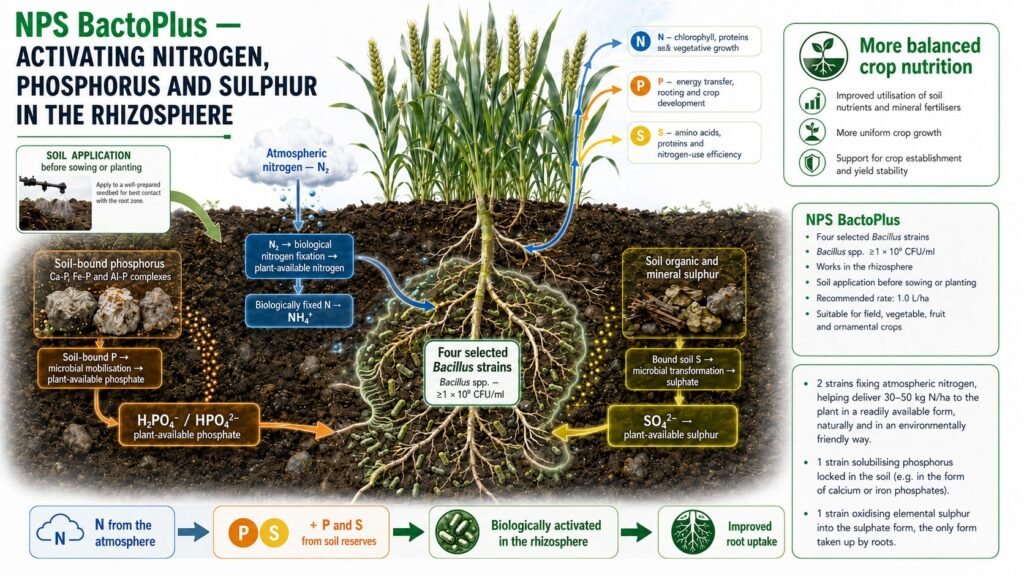
1. NPS BactoPlus – balanced nitrogen, phosphorus and sulphur support in the root zone
NPS BactoPlus contains selected microorganisms supporting biological processes connected with nitrogen availability, phosphorus mobilisation, sulphur transformation, root-zone biological activity and balanced plant nutrition.
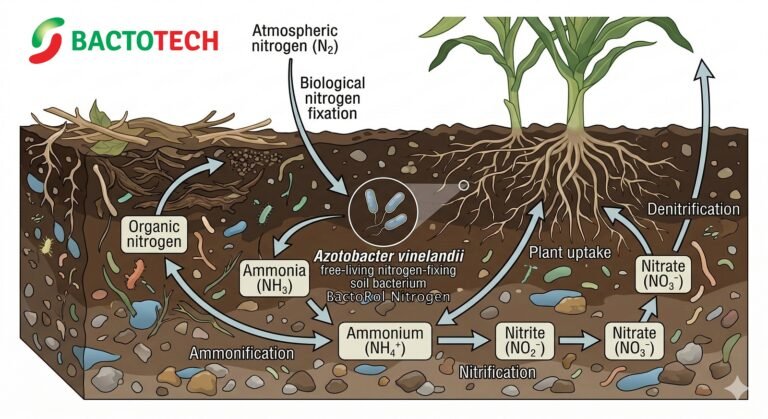
Soils may contain considerable quantities of nutrients, but the presence of a nutrient does not automatically mean it is available to the crop in the correct form or at the time when the plant requires it. NPS BactoPlus is designed to increase biological activity around the root zone and support the conversion of nutrients into forms that can enter the plant-production cycle.
The relationship between sulphur and nitrogen is central. If sulphur availability is insufficient, a crop may have access to nitrogen but use it less effectively.
The often-overlooked relationship between sulphur and nitrogen
Nitrogen is essential for crop growth, but nitrogen nutrition cannot be considered in isolation. Plants require sulphur to produce the sulphur-containing amino acids cysteine and methionine. These amino acids are essential building blocks of plant proteins and enzymes.
The formation of cysteine is one of the main biochemical points at which sulphur metabolism and nitrogen assimilation are connected. Sulphur is therefore not simply an additional nutrient alongside nitrogen. It helps determine how effectively absorbed nitrogen can be converted into amino acids, proteins and productive plant biomass.
By supporting sulphur transformation alongside biological nitrogen processes and phosphorus mobilisation, NPS BactoPlus is not simply a nitrogen proposition. It is a balanced nutrient-efficiency tool designed to help crops convert nutrition into productive growth. NPS BactoPlus is designed to support:
- early root and crop development;
- more consistent growth across the field;
- better conversion of available nitrogen into biomass;
- more efficient use of fertiliser already applied;
- stronger yield formation under variable soil conditions;
- measured and progressive reduction of synthetic fertiliser inputs.
2. SeedVital – supporting crop potential from the beginning
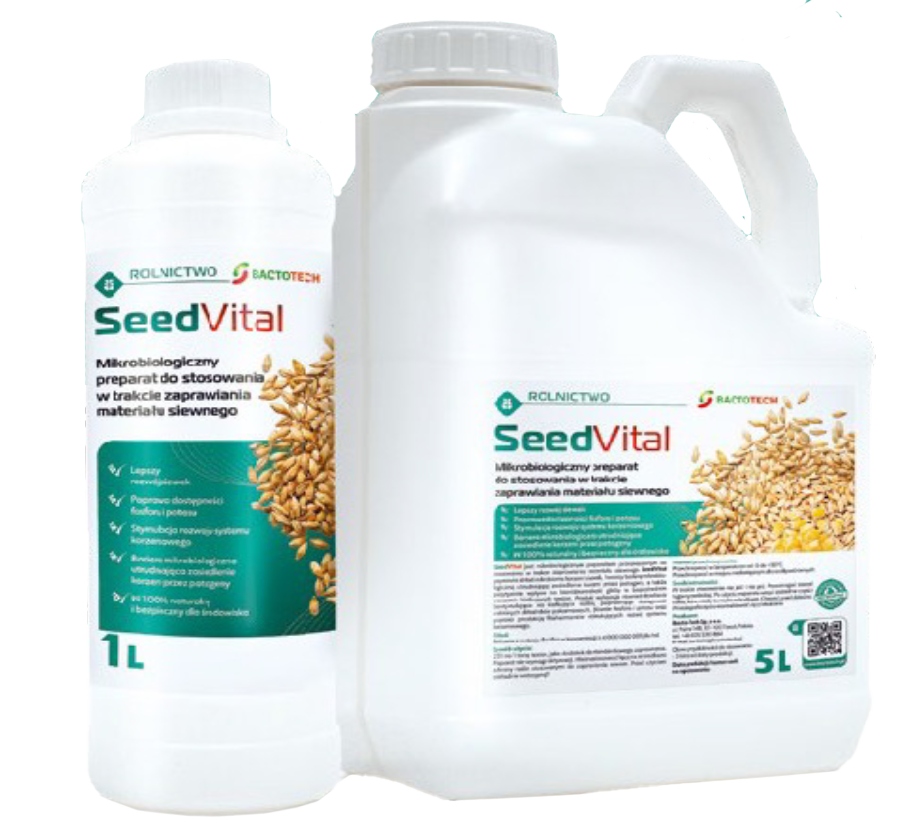
SeedVital is a bacterial treatment for seeds and planting material, designed to support germination, early development and the establishment of a biologically active environment around the emerging root system.
The earliest stage of crop development is also one of the most important. Young seedlings must establish quickly while facing variable temperature, moisture and nutrient availability. Beneficial bacteria associated with the seed and root zone can help the plant support early growth, root development and nutrient access during this critical establishment phase.
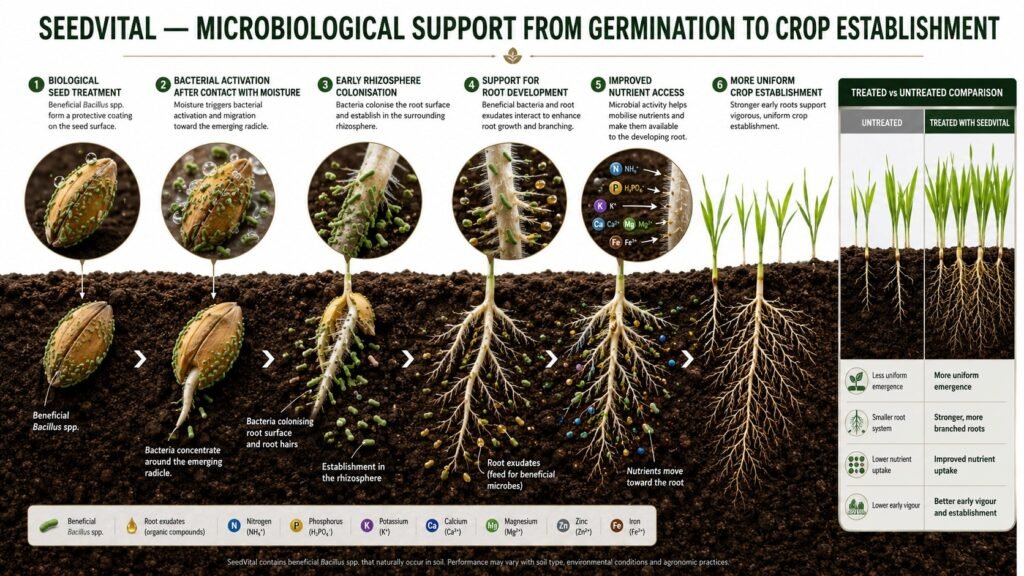
Independent potato trials conducted by IHAR-PIB assessed SeedVital across two locations with different soil and environmental conditions. The research evaluated establishment, crop development, yield structure, marketable yield and tuber size distribution. The results showed that SeedVital supports vegetative development, canopy formation, yield components, a greater proportion of larger marketable produce and a reduced proportion of out-of-spec tubers.
SeedVital is designed to support:
- a more consistent plant population;
- stronger early establishment;
- better use of available space, water and nutrients;
- fewer weak or poorly developed plants;
- improved crop uniformity at harvest;
- a higher proportion of produce meeting market specification.
SeedVital is intended to be used as part of an integrated crop-management programme, alongside good agronomy and crop-specific input planning.
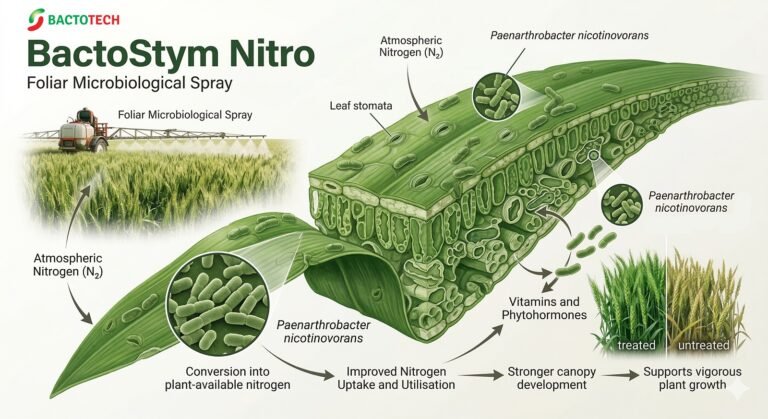
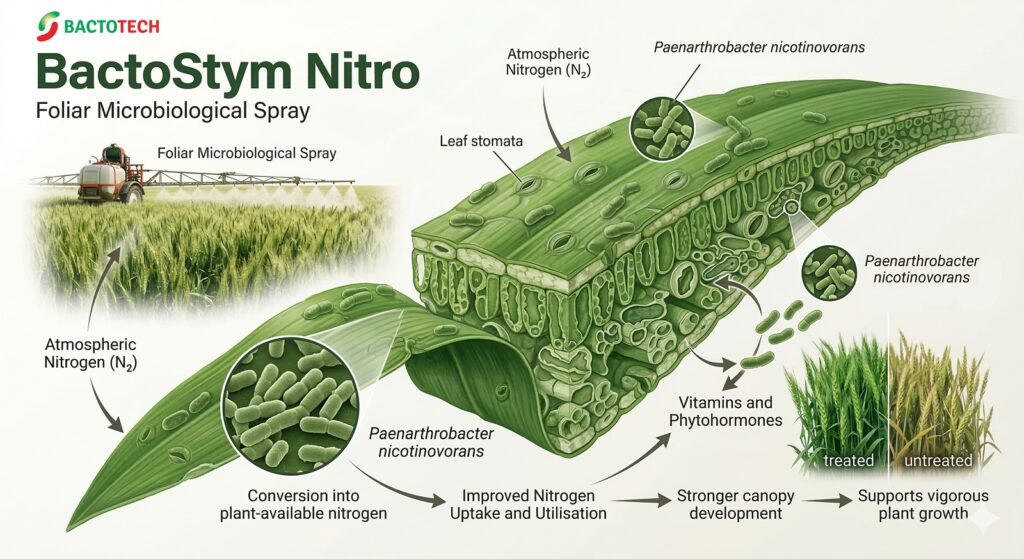
3. BactoStym Nitro – Foliar biological nitrogen support when crop demand is high
BactoStym Nitro is a foliar microbial product containing nitrogen-fixing bacteria. It is applied to the plant canopy and is designed to support biological nitrogen supply and nitrogen-use efficiency during crop development.
This foliar route complements NPS BactoPlus in the soil and root zone. NPS BactoPlus supports nutrient availability below ground, while BactoStym Nitro supports the crop above ground during periods of active canopy development and high nitrogen demand. BactoStym Nitro is designed to support:
- biological nitrogen supply;
- nitrogen-use efficiency;
- canopy formation and vegetative growth;
- crop development during periods of high nitrogen demand;
- plant performance during dry, cold or otherwise challenging growing conditions;
- reduced dependence on additional synthetic nitrogen applications where supported by agronomic advice and crop status.
Independent laboratory testing compared BactoStym Nitro with another commercial nitrogen-fixing foliar product in a growth medium containing no added nitrogen source. Samples were analysed by an external laboratory operating under an accredited quality system. During the test period, BactoStym Nitro demonstrated increasing measured nitrogen forms, particularly ammonium nitrogen, while the comparison product did not show the same pattern.
BactoStym Nitro is not positioned as a complete standalone replacement for nitrogen fertiliser. Its role is to make the nitrogen strategy more resilient and efficient, especially at stages when canopy development and yield formation are vulnerable to nitrogen stress.
4. EntoBalance – Supporting crop vigour and recovery under challenging growing conditions
EntoBalance is a microbial crop-resilience input designed to support root development, nutrient availability, crop vigour and recovery after periods of non-pest environmental stress.
EntoBalance supports crops through the activity of selected beneficial bacteria that help maintain a biologically active environment around plant surfaces and the root zone. By supporting root development and nutrient-use processes, EntoBalance helps the crop maintain access to soil resources during key growth stages. EntoBalance is designed to support:
- root development;
- nutrient availability;
- crop vigour;
- biomass development;
- recovery after abiotic stress;
- marketable yield formation;
- produce quality and uniformity.
EntoBalance can be integrated into a wider microbial crop-nutrition programme where the aim is to support plant performance, nutrient efficiency and crop quality under commercial growing conditions.
How the programme works as one system
Agricultural losses rarely have a single cause. A weakly established plant may develop a smaller root system. A restricted root system may use fertiliser less effectively. Nutrient stress may reduce canopy development. Variable moisture or temperature can then affect crop uniformity, size distribution and final marketable yield.
BactoTech’s programme addresses these connected risks at different points in the crop cycle:
| Crop stage | Technology | Primary role | Commercially relevant KPI |
| Soil and root zone | NPS BactoPlus | Balanced nitrogen, phosphorus and sulphur availability | Synthetic N/P input per tonne of marketable crop; crop uniformity; nutrient-efficiency indicators |
| Seed or planting material | SeedVital | Establishment and early development | Plant count, emergence uniformity, grade-out, reject rate |
| Vegetative development | BactoStym Nitro | Foliar biological nitrogen support | Canopy development, nitrogen-use efficiency, marketable yield |
| Challenging growing conditions | EntoBalance | Root development, crop vigour and abiotic-stress recovery support | Root development, canopy condition, crop uniformity, quality and marketable yield |
Crops where the programme can be adapted
The programme can be adapted to both arable and horticultural production, including cereals, oilseed rape, maize, potatoes, onions and other vegetable crops, and sugar beet.

Zero-disruption integration for supplying farmers
For biological technologies to scale, they must work for busy commercial growers. The BactoTech programme is designed to integrate into existing crop-production routines rather than require a separate machinery platform or a major change in farm infrastructure.
- No new machinery requirement: products can be planned around existing spraying, liquid fertiliser and seed/planting-material treatment systems, subject to label instructions and compatibility checks.
- No capital expenditure barrier: the programme is an input and agronomy integration model, not a hardware, robotics or infrastructure purchase.
- Compatibility-led use: microbial products should not be mixed with products designed to kill bacteria, such as strong bactericides or some copper-based products. Compatibility and timing should be checked before tank mixing.
- Practical storage and transport: BactoTech’s stabilisation approach is designed to make live microbial products stable, transportable and usable in real farm conditions.
- Low-disruption trials: supplier-farm pilots can be run as split-field or side-by-side strip comparisons without interrupting the grower’s existing commercial crop programme.
Validation and technology readiness
Technology readiness status: TRL 7+ candidate – commercially advanced, field-validated and ready for a structured live trial with a retail, food-service or fresh-produce supply-chain partner.
BactoTech is not presenting a laboratory concept. The programme combines existing microbial products with practical application routes and evidence from independent trials and external testing:
- SeedVital: independent IHAR-PIB potato trials across two locations, evaluating establishment, crop development, yield structure, marketable yield and tuber size distribution.
- BactoStym Nitro: external laboratory testing in a nitrogen-free growth medium, showing increasing measured nitrogen forms, particularly ammonium nitrogen, during the test period.
- EntoBalance: independent field evidence assessing crop vigour, root development, crop condition and marketable-yield indicators under commercial-style growing conditions.
- Integrated programme logic: the strongest results are expected when microbial products are integrated into good agronomy, rather than treated as universal replacements for conventional inputs.

What a supplier-farm pilot could measure
A practical pilot with a retail, food-service or fresh-produce supply-chain partner could be designed around grower-standard practice, BactoTech-supported practice and, where agronomically appropriate, a measured 30% reduction in synthetic nitrogen and phosphorus fertilisers. Pilot KPI could include:
- marketable yield by grade;
- percentage of undersized, uneven or rejected produce;
- fertiliser N and P applied per tonne of marketable crop;
- crop establishment and uniformity;
- root and canopy development;
- abiotic-stress indicators;
- grower operational feedback: application timing, machinery, compatibility and labour requirements;
- estimated crop-production footprint and nutrient-loss risk indicators.
These metrics would allow the supply-chain partner, the supplier and BactoTech UK to assess the programme in the same terms that matter commercially: saleable output, input efficiency, operational practicality and resilience.
Reducing reliance on synthetic fertilisers
Incorporating microbial products into crop fertilisation systems allows for a measured reduction of synthetic nitrogen and phosphorus fertilisers by up to 30% without compromising yield or quality. The programme’s objective is to help farmers and growers move from simple input substitution toward input efficiency.
This means improving access to nutrients already present in the soil, supporting biological nitrogen supply, mobilising less-available phosphorus, improving sulphur availability, helping the plant assimilate nitrogen into productive growth and reducing the need for precautionary or inefficient additional applications.
Where supported by soil analysis, crop status, agronomic advice and farm-specific trial data, the programme can be used to evaluate reduced synthetic fertiliser strategies without compromising yield or quality.

Commercial return on investment and scalability
BactoTech’s proposition is deliberately practical: it is not an expensive technology overhaul, but a scalable microbial input programme that can be replicated across different crops and production systems.
The commercial return is built around three levers:
- Input savings: reducing synthetic nitrogen and phosphorus fertiliser by up to 30% can lower exposure to volatile fertiliser markets and reduce dependence on globally traded inputs.
- More marketable crop: stronger establishment, better nutrient efficiency and improved crop uniformity can increase the proportion of produce that reaches saleable specification.
- Lower adoption barrier: because the programme is designed to fit existing farm operations, it avoids the cost and delay associated with new machinery or infrastructure.
For supplying farmers and growers, the value is not only yield. It is the ability to produce more usable food from the same land, water, fertiliser, labour and energy already invested in the crop.
Environmental and supply-chain value
Reducing synthetic fertiliser use creates a practical pathway to lower the carbon footprint of crop production because less fertiliser needs to be manufactured, transported and applied. Improving nutrient-use efficiency also reduces surplus nitrogen and phosphorus in the production system, which can contribute to nutrient losses from fields.
This is especially relevant in Nitrate Vulnerable Zones and environmentally sensitive catchments. The River Wye is a prominent UK example where nutrient overload, particularly phosphorus, has been linked to algal blooms and ecological damage. Technologies that help crops use applied and soil nutrients more efficiently can support both marketable yield and water-quality protection.
For a retailer, this is a Scope 3 supply-chain opportunity: a practical farm input programme that targets crop establisment, fertiliser dependency, nutrient efficiency and the environmental footprint per tonne of food sold.

Why BactoTech UK
BactoTech UK is a UK-based agri-tech startup created to bring practical microbial crop technologies to UK farmers and growers. The company combines UK market presence with BactoTech’s wider European microbiology expertise, proprietary stabilisation technology, independent studies and real-world field testing.
BactoTech formulations are based on selected non-GMO microorganisms and practical quality-control processes, including microbial quality checks. Many BactoTech products are approved for use in organic farming by OF&G in the UK, FiBL Germany and by IUNG-PIB in Poland.
Our aim is to make microbial biology a normal, measurable part of crop nutrition and resilience planning – not a niche experiment. For food retailers, food-service buyers and their suppliers, that means a technology that is practical enough to trial immediately, scalable enough to deploy beyond one farm and measurable enough to support commercial and sustainability decisions.
From stronger plants to less wasted food
Reducing avoidable crop waste requires more than treating symptoms after they appear. It requires supporting the crop at the stages where yield potential is created, developed and converted into a marketable harvest. BactoTech’s integrated microbial programme connects:
balanced nutrition → establishment → nitrogen efficiency → abiotic resilience → marketable yield
The result is a practical biological strategy designed to help farmers and growers produce more usable food from the land, water, fertiliser and energy already invested in the crop – while supporting the need for resilient, sustainable and scalable supply chains.
BactoTech UK is ready to work with a retail, food-service or fresh-produce supply-chain partner to design a low-disruption, data-led supplier-farm trial.
BactoTech microbial products are intended to support crop nutrition, nutrient-use efficiency, root development, crop establishment, abiotic-stress tolerance and crop quality. They are not presented as plant protection products and are not intended to control pests, diseases or pathogens. Where plant protection is required, growers should follow authorised crop-protection programmes and professional agronomic advice.